FIRST AID

|
First aid 2026.pdf Size : 181.238 Kb Type : pdf |
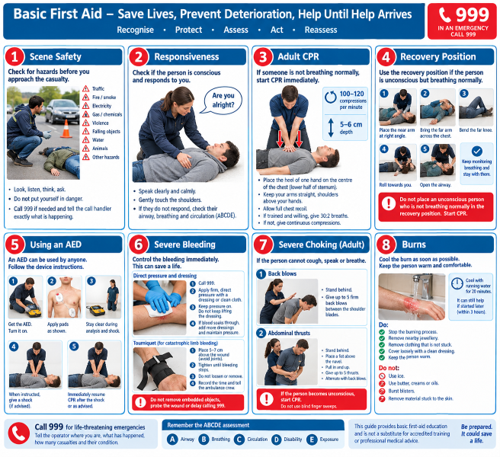
BASIC FIRST AID EDUCATION BOOKLET
A practical introduction to saving life, preventing deterioration and helping until
professional assistance arrives
UK Edition — 2026
Educational resource (c) Daran Oswyn Jones 2026
IMPORTANT
This booklet is designed to provide basic first-aid education.
It does not replace accredited firstaid training, professional medical advice or the
instructions given by an emergency-service call handler.
If someone is seriously ill or injured:
Call 999.
Follow the instructions given by the ambulance service.
Do not put yourself in unnecessary danger.
CONTENTS
What First Aid Really Means/The First Rule — Stay Safe
The Basic Emergency Method
Calling 999
Unconsciousness and the Recovery Position
Cardiac Arrest and CPR
Using an AED
Severe Bleeding
Choking
Shock
Burns and Scalds
Heart Attack
Stroke
Asthma
Anaphylaxis
Seizures
Diabetes and Hypoglycaemia
Serious Head Injury and Concussion
Suspected Spinal Injury
Drowning
Hypothermia
Heat Exhaustion and Heatstroke
Poisoning
Minor Wounds and Injuries
Amputation
Psychological First Aid
Looking After Yourself
The First-Aid Kit
Emergency Preparedness
Practical Training Programme
Quick Reference Emergency Card
Final Principles
- WHAT FIRST AID REALLY MEANS
First aid is not about becoming a doctor.
It is about doing the right things early.
Modern UK guidance describes first aid as help provided by anyone during an
emergency, while recognising their own limitations and obtaining further assistance
when necessary.
The first aiders job is therefore to:
Recognise → Assess → Prioritise → Act → Reassess → Hand over
The 2025 Resuscitation Council UK guidance recommends a structured ABCDE
assessment:
A — Airway
B — Breathing
C — Circulation
D — Disability
E — Exposure
However, one important exception is severe uncontrolled bleeding.
If someone is losing blood catastrophically, control the bleeding immediately rather
than spending unnecessary time completing an assessment first.
This principle is reflected in modern UK military trauma care, where massive
haemorrhage is the first treatment priority.
- THE FIRST RULE — STAY SAFE
Before approaching:
STOP
Look.
Listen.
Think.
Ask:
Is there traffic?
Fire?
Smoke?
Electricity?
Gas?
Dangerous chemicals?
Weapons?
Violent people?
Unstable buildings?
Water?
Falling objects?
Animals?
Other hazards?
Remember:
You cannot help someone effectively if you become the next casualty.
Use gloves or other protective equipment where available.
Do not enter a dangerous environment simply because someone is injured inside it.
Call 999 and tell the emergency service exactly what is happening.
- THE BASIC EMERGENCY METHOD
Use this simple system:
- PROTECT
Protect yourself, the casualty and bystanders.
- RESPOND
Is the person conscious?
Speak loudly:
Are you alright;
Gently stimulate the shoulders if appropriate.
- CALL
If there is a serious or life-threatening problem:
999 — ambulance
Put the phone on speaker if possible.
The ambulance call handler can guide you through CPR and other emergency actions.
- LOOK
Check:
Airway
Can they breathe?
Breathing
Are they breathing normally?
Circulation
Is there serious bleeding?
Disability
Are they confused, unconscious, fitting or showing signs of stroke?
Exposure
Are there burns, injuries, bleeding, environmental problems or other dangers?
- ACT
Treat the immediate life threat.
- REASSESS
Keep checking the casualty.
People can deteriorate.
- CALLING 999
Call 999 for a serious or life-threatening emergency.
Examples include:
unconsciousness
abnormal or absent breathing
cardiac arrest
severe bleeding
major trauma
serious burns
severe chest pain
stroke symptoms
severe breathing difficulty
anaphylaxis
serious poisoning
major drowning incident
Ambulance services specifically identify these types of conditions as reasons
to call 999.
Tell the call handler:
WHERE
Give the exact location.
WHAT
Explain what has happened.
WHO
Tell them how many casualties there are.
CONDITION
Tell them whether the person is:
conscious
breathing normally
bleeding
trapped
deteriorating
Do not hang up unless instructed to do so.
The questions asked by the ambulance service are designed to determine the
appropriate response and can also allow the call handler to give immediate
instructions.
- UNCONSCIOUSNESS AND THE RECOVERY POSITION
If someone is unconscious but breathing normally and there is no immedia
te reason why they must remain in their current position, use the recovery position.
The purpose is to:
keep the airway open
reduce the risk of choking on vomit or fluids
allow continued monitoring
Basic procedure
Place the person on their back.
Kneel beside them.
Place the nearest arm at approximately a right angle.
Bring the far arm across the chest.
Bend the far knee.
Carefully roll the person towards you.
Position the upper leg so the person is stable.
Open the airway.
Continue monitoring breathing.
Stay with them until help arrives.
If a spinal injury is suspected, avoid unnecessary movement. If the airway must be
opened, protect the neck as much as reasonably possible.
CRITICAL
Do not put an unconscious person who is not breathing normally into the recovery
position.
Start CPR.
- CARDIAC ARREST AND CPR
Cardiac arrest is one of the most important emergencies for a member of the public to
recognise.
Suspect cardiac arrest if someone:
is unresponsive
is not breathing normally
is making abnormal gasping or panting sounds
If uncertain:
Assume cardiac arrest.
Call 999 and start CPR.
The 2025 UK guidance recommends starting chest compressions as soon as
possible.
Adult CPR
Place the heel of one hand in the centre of the chest.
Place the other hand on top.
Keep your arms reasonably straight.
Push: (Equivalent pressure to squash a tennis ball)
100–120 compressions per minute
to a depth of at least 5 cm but not more than 6 cm
Allow the chest to return fully between compressions.
If trained and willing to give rescue breaths:
Use:
30 compressions: 2 breaths
If you cannot or do not want to provide rescue breaths continuous chest compressions are appropriate.
Do not waste time worrying about performing CPR perfectly.
Doing something is better than doing nothing.
- USING AN AED
An Automated External Defibrillator (AED) can be used by members of the public.
You do not need to be a doctor.
You do not need to diagnose the heart rhythm.
Basic procedure
Obtain the AED.
Turn it on.
Follow the spoken/visual instructions.
Expose the chest.
Apply the pads as shown.
Do not touch the casualty when the AED analyses.
If instructed to shock, ensure nobody is touching the casualty.
Press the shock button if the device instructs you to.
Immediately resume CPR when instructed.
Modern UK guidance specifically emphasises early AED use and states that anyone can use an AED.
SEVERE BLEEDING
Massive bleeding can kill within minutes.
This is one area where modern military trauma medicine provides an import
ant lesson:
Treat the immediate killer first.
The UK Defence Medical Command identifies catastrophic haemorrhage as
the leading preventable cause of battlefield death and places massive haemorrhage
first within its MARCH system.
Civilian basic approach
- Call 999.
- Apply firm direct pressure.
Use:
a sterile dressing
gauze
a clean cloth
another suitable material if necessary
Press firmly over the bleeding wound.
- Maintain pressure.
Do not repeatedly remove the dressing to see whether bleeding has stopped.
If blood comes through, reinforce the dressing and maintain pressure. (Do noy remove the initial dressing)
- Wound packing
For appropriate deep wounds, trained people may use wound packing, particularly
where direct pressure alone cannot control the bleeding.
- Tourniquet
A commercially manufactured tourniquet can be lifesaving for catastrophic limb
bleeding.
Only use one if appropriate and follow the manufacturers instructions and your training.
Current Defence Medical Command guidance places a tourniquet approximately
5–7 cm above the bleeding site, avoiding joints, when the wound can be located and the
situation permits.
Once applied:
Do not casually loosen or remove it.
Record the application time and tell the ambulance crew.
Never:
remove an embedded object
probe the wound
repeatedly lift dressings to inspect the wound
delay calling 999
If an object is embedded, apply pressure around it rather than pulling it out.
- CHOKING
Mild choking
If the person can:
speak
cough
breathe
encourage them to cough.
Do not interfere unnecessarily.
Severe choking
If they cannot cough effectively, speak or breathe:
Give up to 5 back blows.
If unsuccessful, give up to 5 abdominal thrusts in an adult.
Continue alternating the techniques.
Call 999.
If the person becomes unconscious, begin CPR.
Do not perform blind finger sweeps inside the mouth.
Special procedures apply to infants, young children and pregnant people. (Seek further guidance)
- SHOCK
Shock means the bodys circulation is failing to supply sufficient oxygen to vital organs.
Possible signs include:
pale or clammy skin
weakness
dizziness
rapid breathing
rapid pulse
confusion
anxiety
thirst
collapse
Treatment
Call 999 if serious.
Treat the underlying cause.
Control bleeding.
Keep the person warm.
Reassure them.
Keep monitoring breathing and consciousness.
Do not give food or drink to someone who may require emergency surgery or who is
seriously unwell unless instructed by professionals.
- BURNS AND SCALDS
The NHS recommends:
Cool running water for 20 minutes.
Start as soon as possible.
Cooling can still be useful when begun later, with NHS guidance stating it can be effective within three hours of the injury.
Do:
stop the burning process
remove nearby jewellery
remove clothing that is not stuck
cool with running water
cover loosely afterwards
keep the casualty otherwise warm
Do not:
use ice
use butter
use toothpaste
apply creams or oils
burst blisters
remove material stuck to the skin
Cling film may be laid loosely over a cooled burn where appropriate; do not wrap it
tightly around a limb.
Serious burns require emergency assessment.
- HEART ATTACK
Possible symptoms include:
chest pain or pressure
pain spreading to the arm, jaw, neck, back or stomach
sweating
nausea
breathlessness
dizziness
Action
Call 999.
Keep the person calm and comfortable.
If appropriate, help them administer their own prescribed angina medication.
Current NHS and Resuscitation Council guidance supports an adult with suspected
cardiac chest pain taking 300 mg aspirin, preferably chewed, while awaiting emergency
help, provided they are not allergic to aspirin.
If they become unresponsive and are not breathing normally:
CPR.
- STROKE
Remember:
FAST
F — Face
Has one side of the face drooped?
A — Arms
Can they raise both arms?
S — Speech
Is their speech slurred, confused or unusual?
T — Time
Call 999 immediately.
Stroke symptoms can sometimes disappear temporarily. That does not make the event
safe.
Immediate medical assessment is still required.
- ASTHMA
Help the person sit upright.
Keep them calm.
Help them use their own reliever inhaler.
A spacer should be used if available and appropriate.
Call 999 if: symptoms are severe
they are getting worse
the inhaler is not helping
they do not have their inhaler
Follow the persons asthma action plan where available.
If they become unconscious and stop breathing normally:
CPR.
- ANAPHYLAXIS
Anaphylaxis is a potentially fatal allergic reaction.
Possible signs include:
difficulty breathing
swelling of lips, tongue or throat
wheezing
collapse
widespread allergic reaction
sudden severe illness
Action
- Use their adrenaline auto-injector.
- Call 999.
- Keep them in an appropriate lying position.
If breathing is difficult, they may need to sit or raise their shoulders.
- Do not allow them to stand or walk.
If symptoms have not improved after about five minutes and a second injector is
available, use it according to the prescribed device instructions.
- SEIZURES
A seizure can be frightening.
Do:
protect the person from immediate danger
cushion their head
remove nearby hazards
loosen tight clothing around the neck
note the start time
remain calm
stay with them
After the convulsions stop, place them in the recovery position if appropriate and
monitor breathing.
Do NOT:
restrain them
put anything in their mouth
put your fingers in their mouth
give food or drink until fully recovered
Call 999 when the circumstances indicate an emergency, including prolonged or
repeated seizures, serious injury, breathing difficulty or failure to recover appropriately.
- DIABETES AND HYPOGLYCAEMIA
A hypo is generally a blood glucose level below:4 mmol/L
Possible symptoms include:
sweating
shaking
hunger
confusion
irritability
weakness
dizziness
abnormal behaviour
visual disturbance
If the person is awake and able to swallow safely:
Give rapidly absorbed sugar, such as:
glucose tablets
glucose gel
sugary drink
fruit juice
Recheck after approximately 10–15 minutes and repeat treatment if necessary.
Once recovered, longer-acting carbohydrate may be required.
If unconscious:
Do not give food or drink.
Place them in the recovery position and call 999 when appropriate.
If a prescribed glucagon injection is available and someone knows how to administer it, it may be used according to the persons treatment plan.
- SERIOUS HEAD INJURY AND CONCUSSION
Possible warning signs include:
loss of consciousness
confusion
repeated vomiting
severe headache
abnormal behaviour
seizure
weakness or numbness
difficulty speaking
deteriorating consciousness
A person with suspected concussion should stop physical activity and obtain
appropriate medical assessment.
A worsening casualty requires urgent medical attention.
- SUSPECTED SPINAL INJURY
Consider spinal injury after:
major road traffic collision
fall from height
diving accident
major impact
direct blow to the back or neck
severe neck/back pain
weakness or paralysis
Do not move the casualty unnecessarily.
Exception:
If the person is in immediate danger, or their airway cannot otherwise be maintained,
movement may be necessary. Airway and life preservation always remain priorities.
- DROWNING
Water emergencies require two priorities:
Rescue safely.
Restore breathing.
Do not enter dangerous water unless you have the appropriate ability and equipment.
Where possible:
Reach — Throw — Row — Go
Try to assist from a safe position.
Once the person is safely out:
assess responsiveness
assess breathing
call 999
provide CPR if required
prevent further heat loss
The 2025 Resuscitation Council guidance specifically emphasises flotation, safe
removal from water and prevention of hypothermia.
- HYPOTHERMIA
Hypothermia occurs when core body temperature falls below approximately 35°C.
Possible signs:
shivering
cold skin
confusion
slurred speech
slow breathing
tiredness
deterioration in consciousness
Action
move to shelter
remove wet clothing
wrap in dry insulation
cover the head
keep them awake if possible
call 999 for suspected significant hypothermia
Do not:
rub their limbs
use a hot bath
use intense direct heat
give alcohol
NHS guidance treats hypothermia as a medical emergency.
- HEAT EXHAUSTION AND HEATSTROKE
Heat exhaustion
Possible symptoms:
sweating
weakness
dizziness
headache
nausea
cramps
thirst
Move the person somewhere cool.
Remove unnecessary clothing.
Give suitable fluids if they are alert and able to drink.
Cool the skin.
Heatstroke
Heatstroke is an emergency.
Warning signs include:
very high temperature
confusion
abnormal behaviour
rapid breathing
rapid heartbeat
seizure
loss of consciousness
Call 999.
Begin active cooling while waiting for help.
NHS guidance recommends cooling with water, fanning and other appropriate method.
- POISONING
Poisoning can occur through:
swallowing
inhalation
skin contact
medicines
household chemicals
gases
pesticides
plants
other substances
Action
Seek medical advice immediately.
Call 999 if there is:
unconsciousness
severe breathing difficulty
seizure
stopped breathing
serious deterioration
Do NOT:
make the person vomit
give food or drink unless instructed
expose yourself to the substance
Keep the packaging or substance information available for emergency servic
es if it can be done safely.
- MINOR WOUNDS AND INJURIES
For minor cuts and grazes:
Wash your hands. (Wear gloves)
Control bleeding with gentle pressure.
Clean the wound.
Cover with an appropriate dressing.
Monitor for infection.
Seek medical advice if:
bleeding will not stop
the wound is deep
there is loss of sensation or movement
there is a foreign object
an animal or human bite is involved
infection develops
- AMPUTATION
A traumatic amputation is a major emergency.
First priority:
Control life-threatening bleeding.
Call 999.
If the amputated part can be safely recovered:
Wrap it in sterile material or a clean cloth moistened with saline/water.
Put it into a clean waterproof bag/container.
Place that container in another container containing ice/cold water.
Do not allow the tissue to touch ice directly.
Send it with the casualty to hospital.
Do not waste time recovering the body part while uncontrolled catastrophic
bleeding continues.
The 2025 Resuscitation Council guidance specifically places bleeding control
before preservation of an amputated body part.
- PSYCHOLOGICAL FIRST AID
An emergency can affect the mind as well as the body.
A person may experience:
fear
panic
confusion
anger
shock
crying
emotional numbness
disorientation
Your role
Be calm.
Introduce yourself.
Explain what you are doing.
Use simple language.
Help establish safety.
Do not force someone to discuss traumatic experiences.
Do not promise outcomes you cannot guarantee.
Where appropriate, help them contact family, friends or professional support.
Psychological support should be treated as part of caring for the casualty rat
her than an optional extra.
- LOOKING AFTER YOURSELF
First aid can be physically and emotionally demanding.
After a serious incident:
move away from danger
sit down if necessary
drink water
seek support
talk to someone you trust
recognise that emotional reactions can occur later
A rescuer who becomes overwhelmed may need assistance too.
The first aider is also a human being.
- THE BASIC FIRST-AID KIT
A useful household kit may contain:
Essential
disposable nitrile gloves
sterile dressings
adhesive dressings
roller bandages
triangular bandages
sterile gauze
medical tape
antiseptic wipes
scissors
tweezers
disposable CPR face shield
instant cold pack
emergency blanket
safety pins
eye-wash solution
Useful additions
haemostatic dressing
commercially manufactured tourniquet
trauma dressing
burn dressing
saline
torch
marker pen
notepad
emergency contact card
Equipment should be checked regularly.
Know how to use what you carry.
Buying equipment is not the same as being trained to use it.
The 2025 Resuscitation Council guidance explicitly advises first aid providers to use
equipment and medications only within their training and competence.
- EMERGENCY PREPAREDNESS
Good first aid begins before the emergency. Do your reading. Involve the children.
Every household should know:
Where is the first-aid kit?
Where is the nearest AED?
Who knows CPR?
Where is the nearest hospital?
Who should be contacted in an emergency?
Does anyone have:
allergies?
asthma?
diabetes?
epilepsy?
important medication?
medical alert information?
Keep important information accessible.
Learn CPR.
Attend an accredited first-aid course.
Practise emergency scenarios.
- PRACTICAL TRAINING PROGRAMME
A basic education programme should not consist solely of reading.
Lesson 1 — Emergency awareness
Learn:
danger
personal safety
emergency services
scene assessment
communication
Practical exercise
Identify hazards in a simulated room.
Lesson 2 — Primary assessment
Learn:
Response → Airway → Breathing → Circulation → Disability → Exposure
Practical exercise
Conduct a simulated primary assessment.
Lesson 3 — CPR and AED
Learn:
cardiac arrest recognition
chest compressions (approximately the pressure required to squash a tennis ball)
rescue breaths
AED operation
Practical exercise
CPR manikin and AED trainer.
Lesson 4 — Severe bleeding
Learn:
direct pressure
dressings
wound packing principles
tourniquet awareness
Practical exercise
Bleeding-control simulation using training equipment.
Lesson 5 — Choking
Practise:
recognition
coughing
back blows
abdominal thrusts
CPR following collapse
Lesson 6 — Medical emergencies
Recognise:
heart attack
stroke
asthma
anaphylaxis
hypoglycaemia
seizures
Lesson 7 — Environmental emergencies
Recognise:
burns
hypothermia
heat illness
drowning
Lesson 8 — Scenario training
Combine everything.
Example:
You arrive at a roadside incident. One person is unconscious, another has severe
bleeding and another is distressed.
The learner must:
identify hazards
call 999
prioritise casualties
control catastrophic bleeding
assess consciousness and breathing
begin CPR if required
use an AED
continue reassessment
communicate effectively with ambulance crews
- QUICK-REFERENCE EMERGENCY CARD
DANGER
Is it safe?
↓
RESPONSE
Are they conscious?
↓
MASSIVE BLEEDING
Control it immediately.
↓
AIRWAY
Is it open?
↓
BREATHING
Are they breathing normally?
↓
NOT BREATHING NORMALLY
999 → CPR → AED
↓
BREATHING NORMALLY BUT UNCONSCIOUS
Recovery position + monitor
↓
MEDICAL EMERGENCY
Think:
FAST — Stroke
Chest pain — Heart attack
Breathing difficulty — Asthma/anaphylaxis
Confusion/sweating — Hypoglycaemia
Seizure — Protect and monitor
↓
REASSESS
Has anything changed?
THE FIVE GOLDEN RULES
- PROTECT YOURSELF
Do not become another casualty.
- CALL FOR HELP EARLY
999 is there for life-threatening emergencies.
- TREAT WHAT WILL KILL FIRST
Catastrophic bleeding and failure of breathing demand immediate action.
- DO WHAT YOU ARE TRAINED TO DO
Do not exceed your competence.
- NEVER STOP REASSESSING
A casualty’s condition can change.
FINAL PRINCIPLE
First aid is not about performing medicine perfectly.
It is about recognising danger, making sensible decisions and taking effective
action during the critical minutes before professional help arrives.
The modern UK approach combines:
Safety
Early recognition
Early communication
Structured assessment
Immediate treatment of life threats
Continuous reassessment
Professional handover
The greatest barrier to effective first aid is often not lack of equipment.
It is hesitation.
You do not need to be a doctor to help save a life.
You need to:
STOP. THINK. CALL. ACT.
And keep going until professional help takes over.
SOURCE BASIS
This booklet has been constructed from current UK authoritative guidance, principally:
Resuscitation Council UK — 2025 First Aid Guidelines
Resuscitation Council UK — 2025 Adult Basic Life Support Guidelines
NHS England/NHS health information
NHS ambulance-service public emergency guidance
South Central Ambulance Service
Northeast Ambulance Service
UK Defence Medical Command Clinical Guidelines
UK Tactical Combat Casualty Care principles where relevant to civilian trauma Education
The 2025 Resuscitation Council UK guidance is particularly important because it introduced a dedicated first aid chapter and establishes first aid as the first link in the chain of survival.
UK Defence Medical Commands current guidance, including its October 2026 review of care for injured patients and its current approach to MARCH based trauma assessment.
This booklet should be reviewed whenever major UK first aid or resuscitation guidance changes.
Educational edition — 2026
(C) Daran Oswyn Jones 2026