Emergency & Disaster Resilience Manual.
(C) Daran Oswyn Jones 2026



|
Preparedness PDF Checklist.pdf Size : 199.501 Kb Type : pdf |
EMERGENCY & DISASTER RESILIENCE MANUAL
A Practical Guide to Personal, Family and Community Resilience
Daran Oswyn Jones, BA (Hons), MA
© Daran Oswyn Jones 2026
CONTENTS
Part I — Introduction and Resilience Philosophy
Part II — Fundamental Needs
Part III — Water
Part IV — Sanitation
Part V — Fire
Part VI — Shelter
Part VII — Clothing
Part VIII — Food
Part IX — Food Preservation
Part X — Cooking
Part XI — Light
Part XII — Electricity
Part XIII — Communication
Part XIV — Local Resilience Network
Part XV — Navigation
Part XVI — Medical
Part XVII — Foot Care
Part XVIII — Tools
Part XIX — Repair Kit
Part XX — Natural Resources
Part XXI — Cordage
Part XXII — Transport
Part XXIII — Information
Part XXIV — Home Security and Safety
Part XXV — Garden Resilience
Part XXVI — 1920s Resilience Principles
Part XXVII — Military-Style Field Principles
Part XXVIII — 72-Hour Kit
Part XXIX — 7-Day System
Part XXX — 30-Day System
Part XXXI — 3–6 Month System
Part XXXII — Resilience Checklist
Part XXXIII — Resilience Rule of Three
Part XXXIV — £0 Survival Programme
Part XXXV — Master Acquisition Order
Final Thoughts — Keeping People Going
Final Principle
PART I — INTRODUCTION AND RESILIENCE PHILOSOPHY
Emergency and disaster resilience is not about predicting every possible disaster. It is about developing the knowledge, equipment, habits, relationships and flexibility necessary to continue functioning when normal systems temporarily fail.
This manual combines:
-
historical resilience knowledge;
-
military-style field principles;
-
outdoor and campcraft skills;
-
emergency and disaster management;
-
first aid;
-
water management;
-
food storage and preservation;
-
energy and lighting;
-
communications;
-
navigation;
-
gardening;
-
repair and maintenance;
-
modern technology;
-
household preparedness;
-
community cooperation.
The objective is not to become isolated from society.
The objective is to become less vulnerable when normal infrastructure is disrupted.
The Guiding Philosophy
Prepare cheaply.
Learn continuously.
Maintain what you own.
Create redundancy.
Help your neighbours.
Avoid unnecessary risk.
Preparedness should be progressive.
Begin with knowledge and organisation. Then acquire inexpensive equipment. Build skills through practice. Improve systems gradually.
Do not spend money simply because an item is marketed as a survival product.
Ask:
-
What problem does this solve?
-
Do I already have something that performs the same function?
-
Can I learn to perform the function manually?
-
What happens if this item fails?
-
Do I have an alternative?
The Seven-Stage Emergency Method
1. ASSESS
Determine what has happened and identify immediate hazards.
2. PROTECT
Protect people from fire, electricity, contaminated water, structural damage, extreme weather and other immediate threats.
3. SHELTER
Establish safe protection from weather and environmental exposure.
4. WATER
Secure safe drinking water before concentrating on less-critical supplies.
5. FIRE / ENERGY
Establish safe sources of heat, cooking, lighting and electrical power.
6. COMMUNICATE
Find out what is happening, maintain contact and obtain reliable information.
7. SUSTAIN
Manage food, sanitation, medical needs, repairs, transport and community support.
Priority System
P1 — Critical
Required to protect life and prevent immediate harm.
P2 — Important
Required to maintain health, safety and basic functioning.
P3 — Useful
Improves resilience, comfort or efficiency.
P4 — Advanced
Long-term or specialist improvements.
Cost Bands
£0 — knowledge, organisation, existing household resources.
£ — inexpensive basic equipment.
££ — moderate investment.
£££ — substantial investment.
££££ — major long-term infrastructure.
The principle is simple:
The best preparedness system is one that people can actually afford, understand, maintain and use.
PART II — FUNDAMENTAL NEEDS
In an emergency, concentrate on fundamental human requirements before convenience.
Basic Requirements
PEOPLE → WATER → SHELTER → HEAT/ENERGY → FOOD → MEDICAL CARE → COMMUNICATION → SANITATION → TOOLS → TRANSPORT → COMMUNITY
The order may change according to circumstances.
For example, during a flood, immediate evacuation may take priority over gathering possessions.
During a winter power failure, warmth may become immediately critical.
During a water-contamination incident, safe drinking water becomes the priority.
Fundamental Rule
Protect people first.
Do not take unnecessary risks to save property or equipment.
Ask:
-
Are people safe?
-
What immediate hazards exist?
-
What resources are available?
-
What resources are disappearing?
-
What must be done now?
-
What can wait?
-
What alternatives exist?
PART III — WATER
The Most Important Resource
Water is essential for:
-
drinking;
-
food preparation;
-
hygiene;
-
sanitation;
-
medical care;
-
cooking;
-
cleaning.
IMPORTANT WARNING
NOT ALL WATER IS SAFE TO DRINK.
Water can contain:
-
bacteria;
-
viruses;
-
parasites;
-
sewage;
-
chemicals;
-
pesticides;
-
fuel;
-
industrial contaminants;
-
heavy metals;
-
other hazardous substances.
Clear water is not necessarily safe water.
Water Sources
Potential sources include:
-
stored drinking water;
-
bottled water;
-
tap-water reserves;
-
bath water;
-
pots and pans;
-
rainwater;
-
roof and gutter collection;
-
ponds;
-
rivers;
-
streams;
-
other carefully assessed sources;
-
fog collection.
If mains-water interruption is anticipated, fill the bath where appropriate.
However, retain some pots and pans for cooking and other essential uses.
Bottled Water
Store bottled water:
-
away from direct sunlight;
-
away from chemicals;
-
away from heat;
-
in suitable conditions;
-
where it cannot easily be contaminated or damaged.
Rainwater
A basic system is:
COLLECT → SETTLE → FILTER → PURIFY → STORE
Rainwater collected from roofs and gutters may contain:
-
bird droppings;
-
dirt;
-
leaves;
-
roofing contaminants;
-
chemical residues.
Filtering alone does not necessarily make it safe.
Fog Harvesting
In suitable environments:
FOG → MESH → GUTTER → COLLECTION TANK
Fog harvesting can provide useful water, but collected water still requires appropriate treatment before drinking.
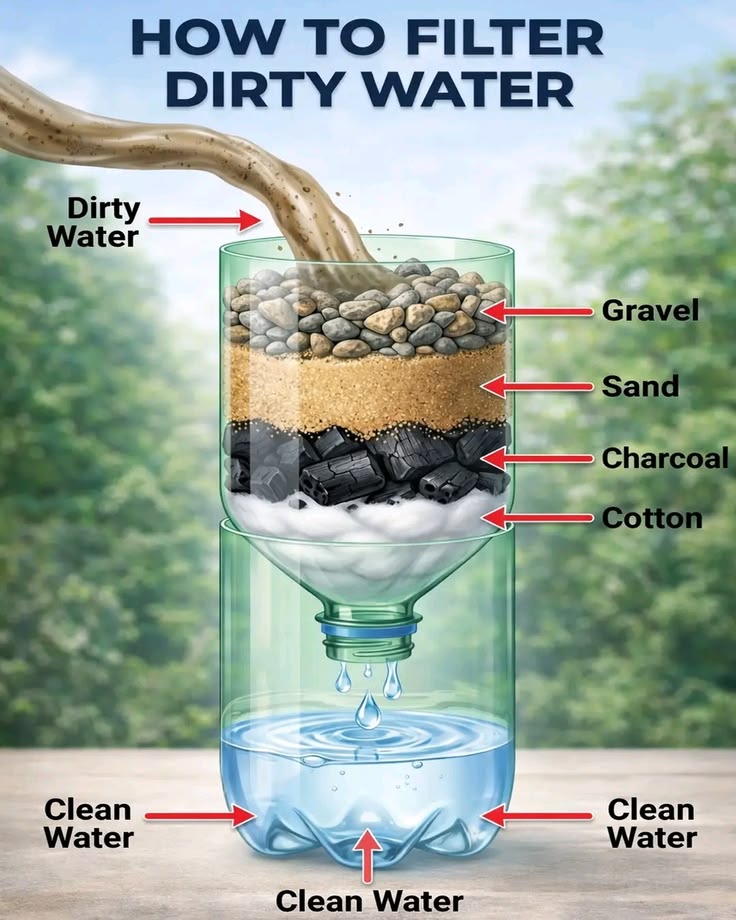
Filtration and Purification
Cloth and sand may remove visible particles.
Charcoal or activated carbon can assist with certain contaminants.
However:
Charcoal alone does not reliably disinfect water.
Neither cloth nor sand filtration should automatically be considered sufficient for drinking water.
Water potentially contaminated with:
-
fuel;
-
pesticides;
-
industrial chemicals;
-
sewage;
-
other hazardous chemicals
may not be made safe simply by boiling.
Follow appropriate authoritative water-treatment guidance for the specific situation.
Drinking and Non-Drinking Water
Maintain a clear distinction between:
DRINKING WATER
and
NON-DRINKING WATER
Label containers clearly.
Non-drinking water may still be useful for:
-
flushing;
-
cleaning;
-
gardening;
-
some sanitation tasks.
Never assume that water collected for these purposes is safe to drink.
PART IV — SANITATION
Sanitation becomes critically important when:
-
mains water fails;
-
toilets cannot be flushed;
-
sewage systems are overloaded;
-
waste collection stops;
-
temporary accommodation is required;
-
illness is present.
The objectives are to:
-
prevent contamination;
-
protect drinking water;
-
protect food;
-
protect skin and clothing;
-
reduce infection;
-
control odour;
-
contain waste;
-
maintain personal hygiene.
Basic Sanitation Inventory
Useful supplies include:
-
toilet paper;
-
soap;
-
hand sanitiser;
-
disinfectant;
-
antiseptic wipes;
-
heavy-duty/contractor bags;
-
approximately 3 mm thick contractor bags where suitable;
-
bucket;
-
gloves;
-
nitrile gloves;
-
cloths;
-
wet wipes;
-
toothbrush and toothpaste;
-
appropriate personal hygiene supplies;
-
woodchip;
-
woodchip-based cat litter;
-
hydrogen peroxide where appropriately used;
-
unscented plain household bleach where appropriately used;
-
N95 or another appropriate particulate respirator;
-
eye protection where appropriate.
Personal Hygiene
Soap and clean water remain preferable where available.
Antiseptic wipes can be useful for emergency body cleaning, but they are not automatically suitable for prolonged whole-body use.
Follow product instructions and consider:
-
skin sensitivity;
-
intended use;
-
avoiding eyes;
-
avoiding sensitive areas unless the product is specifically intended for them.
Mouth Hygiene
Hydrogen peroxide should only be used for oral rinsing where the product is specifically intended for oral use and according to manufacturer or health-professional instructions.
Never swallow it.
Do not improvise concentrated solutions.
Household-strength hydrogen peroxide is not automatically a mouthwash.
Stop using it if irritation occurs.
Water Container Sanitising
Hydrogen peroxide may be suitable for some container-cleaning applications when:
-
the product is appropriate;
-
the container material is compatible;
-
instructions are followed;
-
the container is appropriately rinsed or prepared before drinking-water use.
Gloves
Use nitrile gloves where appropriate.
Where practical:
DOUBLE-GLOVE → COMPLETE TASK → REMOVE OUTER GLOVES → REMOVE INNER GLOVES → WASH HANDS
Avoid touching:
-
the face;
-
food;
-
clean drinking water;
-
clean equipment
while wearing contaminated gloves.
Gloves do not replace hand hygiene.
Respiratory Protection
N95 or another suitable particulate respirator may be appropriate where drying, splashing, aerosolisation or contaminated dust presents a respiratory hazard.
Use correctly and maintain or replace according to manufacturer guidance.
Eye protection should be considered where splashing is possible.
Emergency Toilet
A simple emergency toilet system can be:
TOILET → HEAVY-DUTY BAG → ABSORBENT MATERIAL → SECURE CLOSURE → SAFE DISPOSAL
Procedure:
-
Place a strong heavy-duty/contractor bag inside a suitable toilet or container.
-
Place a couple of handfuls of woodchip or woodchip-based cat litter in the bottom.
-
Use the toilet.
-
Add additional absorbent material as required.
-
Do not overfill.
-
Close and secure the bag.
-
Use a second bag where appropriate.
-
Store securely away from:
-
children;
-
animals;
-
food;
-
drinking water.
-
-
Follow local-authority or emergency disposal arrangements.
Use woodchip-based material rather than granular cat litter for this system.
Contractor Bags
Approximately 3 mm thick contractor bags may provide greater strength, but actual construction varies by manufacturer.
Inspect bags before use.
Do not rely solely on thickness.
Avoid:
-
sharp objects;
-
excessive weight;
-
overfilling;
-
dragging bags across rough surfaces;
-
allowing leaks.
Double-bag where appropriate.
Cleaning and Disinfection
Follow product instructions for:
-
dilution;
-
contact time;
-
ventilation;
-
PPE;
-
surface compatibility;
-
rinsing requirements.
Bleach
Unscented plain household bleach may be appropriate for sanitation and disinfection in suitable circumstances.
For drinking-water treatment, use only specific products and current authoritative instructions that explicitly support that use.
Never guess a drinking-water bleach dosage.
Never use:
-
scented bleach;
-
perfumed bleach;
-
bleach containing unsuitable additives;
-
unidentified products.
Never Mix Bleach With:
-
ammonia;
-
acids;
-
toilet cleaners;
-
vinegar;
-
other chemicals.
Maintain ventilation and appropriate PPE.
Waste Procedure
PROTECT → CONTAIN → SEAL → CLEAN → DISINFECT → WASH → DISPOSE
The fundamental sanitation principle is:
Contain waste before it contaminates people, food or water.
Sanitation System
PERSONAL HYGIENE → TOILET CONTAINMENT → WASTE HANDLING → CLEANING → DISINFECTION → HAND HYGIENE → SAFE DISPOSAL
PART V — FIRE
Fire provides:
-
heat;
-
cooking;
-
light;
-
morale.
It is also one of the greatest household hazards.
Basic Fire Inventory
-
disposable lighter;
-
waterproof matches;
-
ferro rod;
-
tealight candles;
-
muffin baking tin;
-
hand sanitiser;
-
wire wool;
-
dry tinder;
-
cotton;
-
wax;
-
newspaper;
-
steel wool;
-
9V battery;
-
small axe;
-
folding saw;
-
thick heat-resistant gloves;
-
fire gloves;
-
metal bucket;
-
fire extinguisher.
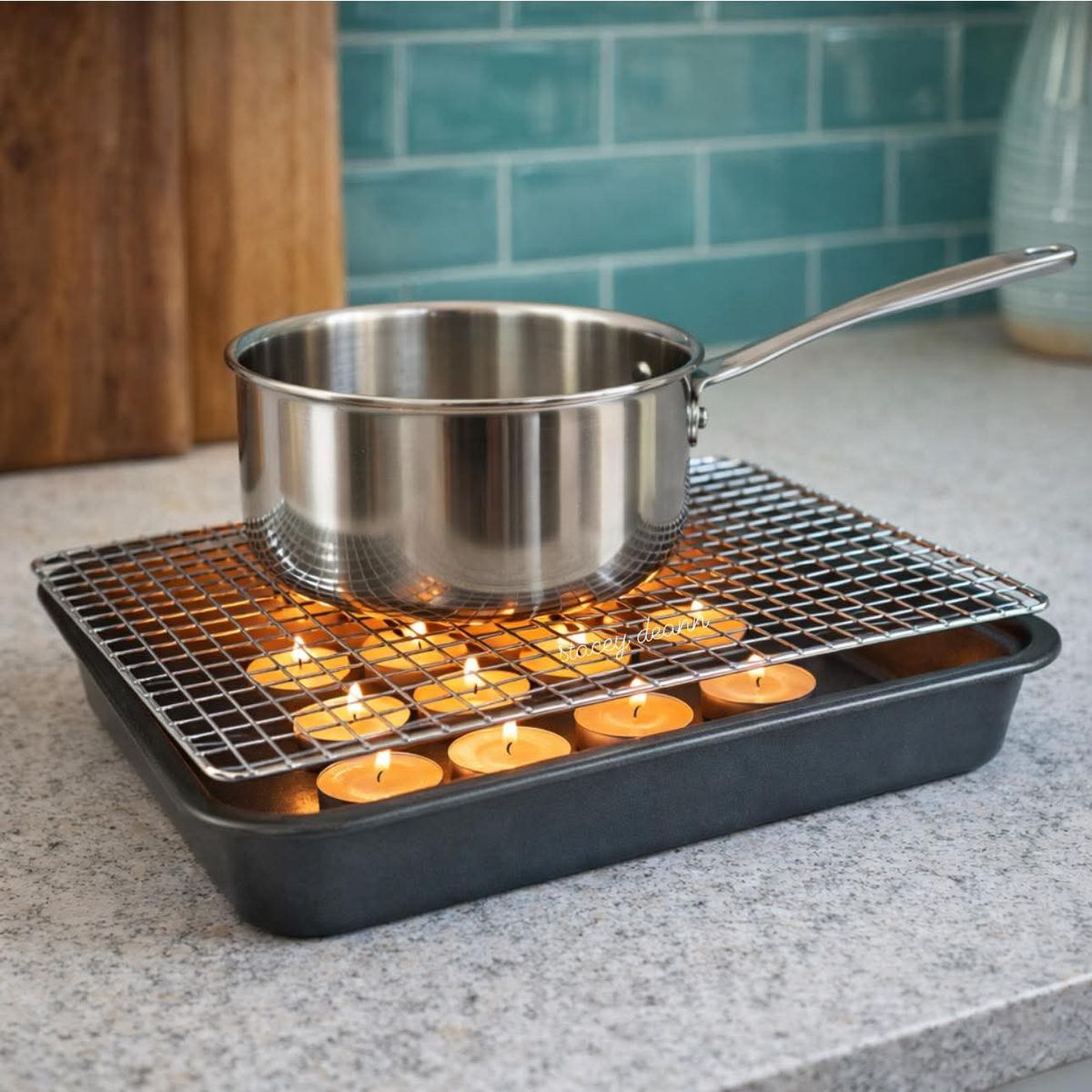
Tealight System
Tealights can provide limited emergency heat and cooking capability when used carefully.
A muffin baking tin can hold multiple tealights.
Use only on a stable, fire-resistant surface.
Never leave burning candles unattended.
Emergency Ignition
Some emergency fire-starting methods include:
HAND SANITISER + WIRE WOOL
and
9V BATTERY + STEEL WOOL
These methods involve fire hazards and should be performed only with appropriate caution, ventilation and safe materials.
Advanced Historical Method
Potassium permanganate and glycerol is an advanced historical fire-starting method.
It involves a strong oxidising agent and combustible material.
It should not be:
-
premixed;
-
experimented with using improvised quantities;
-
carried as a premixed substance;
-
used indoors.
Safer methods should be preferred.
PART VI — SHELTER
Shelter protects against:
-
cold;
-
heat;
-
wind;
-
rain;
-
exposure.
Inventory
-
emergency blanket;
-
tarp;
-
groundsheet;
-
cordage;
-
paracord;
-
sleeping bag;
-
wool blanket;
-
sleeping mat;
-
tent;
-
waterproof clothing;
-
bin bags;
-
duct tape;
-
needle and thread.
Avoid shelter locations exposed to:
-
flood channels;
-
unstable slopes;
-
falling trees;
-
structural collapse;
-
fire;
-
other environmental hazards.
PART VII — CLOTHING
Use layers:
-
Base layer
-
Insulation layer
-
Waterproof outer layer
Protect:
-
head;
-
hands;
-
feet.
Clothing Repair
Keep:
-
needle and thread;
-
buttons;
-
safety pins;
-
patches;
-
shoelaces;
-
cord;
-
tape.
The objective is to make clothing last longer rather than treating damaged clothing as disposable.
PART VIII — FOOD
Emergency Foods
Useful foods include:
-
oats;
-
crackers;
-
tinned foods;
-
dried fruit;
-
nuts;
-
peanut butter;
-
cereal;
-
chocolate;
-
biscuits.
Pantry Resilience
Maintain sensible supplies of:
-
rice;
-
pasta;
-
lentils;
-
beans;
-
flour;
-
salt;
-
sugar;
-
cooking oil;
-
stock;
-
dried vegetables;
-
tea;
-
coffee.
Use FIFO — FIRST IN, FIRST OUT.
Eat older stock first and replace it with newer supplies.
PART IX — FOOD PRESERVATION
Food preservation extends the useful life of food and reduces dependence upon refrigeration and continuous shopping.
Methods include:
-
drying;
-
salting;
-
pickling;
-
fermentation;
-
smoking;
-
cellaring;
-
canning;
-
freezing;
-
low-energy cooling.
Established safe procedures should be followed.
Low-acid canning requires particular care because unsafe processing can create serious food-safety hazards.
Freezer Management
Where freezer space is available, filled water bottles can be used to occupy gaps and provide thermal mass.
Do not compromise food safety or block necessary airflow.
Ceramic Pot-in-Pot Cooling
A ceramic pot-in-pot system can use:
INNER POT → SAND → OUTER POT → WATER → EVAPORATIVE COOLING
Keep it shaded and ventilated.
Underground/Shaded Storage
A shaded garden hole approximately three feet deep may provide cooler storage in suitable circumstances.
However, temperature, moisture, pests and food safety must be carefully considered.
Do not assume underground storage automatically makes food safe.
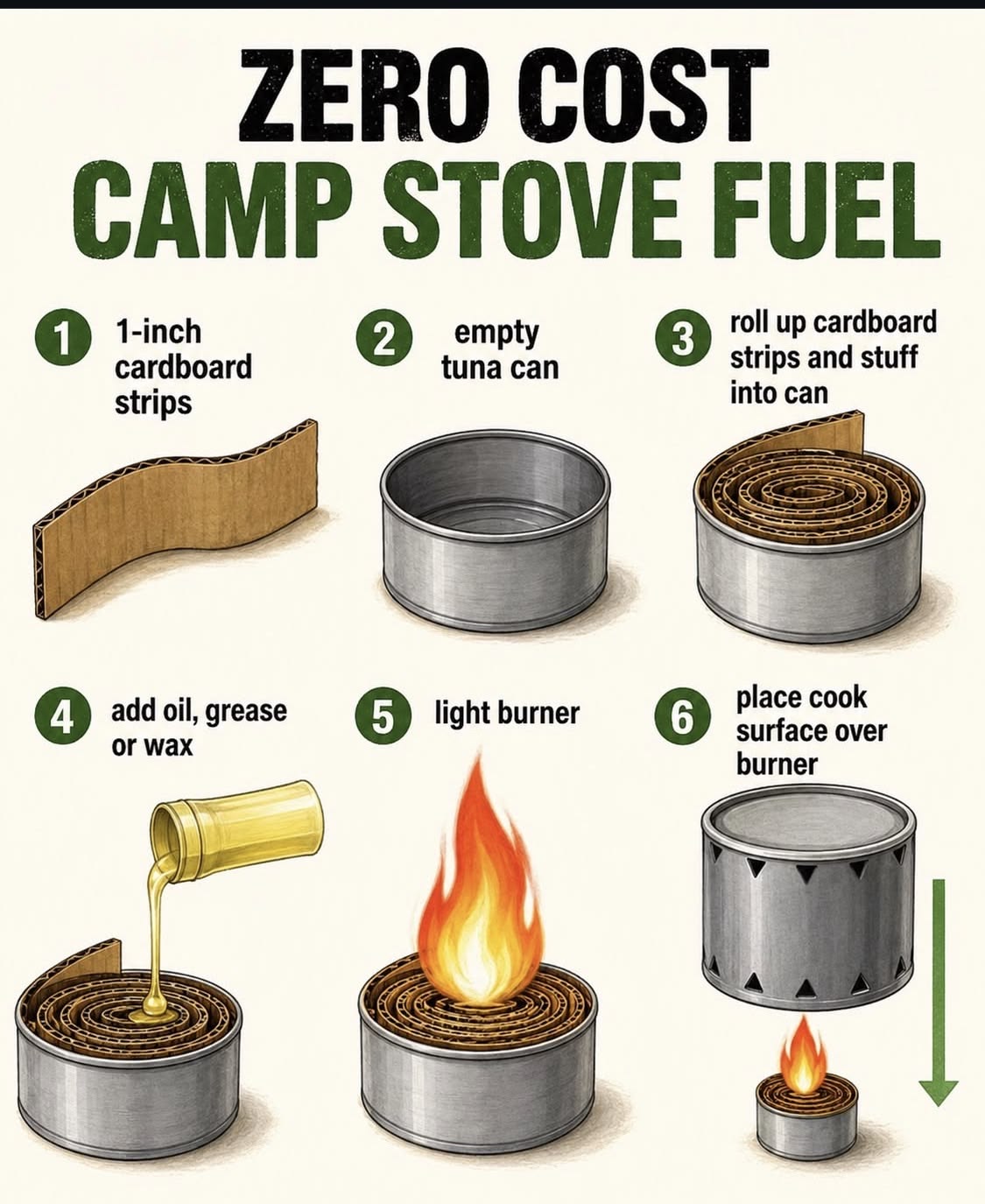
PART X — COOKING
Use a three-layer system:
1. Household Cooker
Normal cooking facilities.
2. Purpose-Designed Camping Stove
A suitable outdoor camping stove provides an alternative.
3. Emergency Alternatives
Potential alternatives include:
-
tealight cooking;
-
garden BBQ;
-
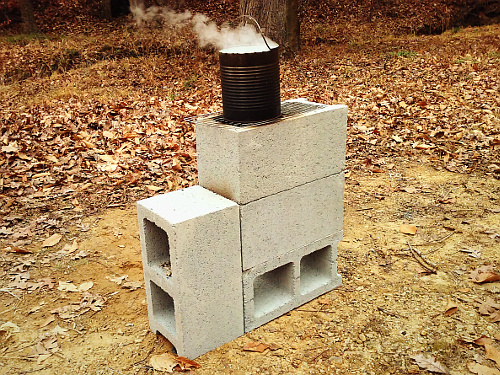
breeze-block rocket stove;
-
outdoor open fire.
Tealight Cooking
Four tealights can be placed in a muffin baking tin.
A suitable cooking container can be raised on stable, heat-resistant supports such as suitable jar lids or equivalent supports.
Ensure the arrangement is stable and cannot easily tip.
Emergency Outdoor Cooking
A garden BBQ, suitable rocket stove or properly controlled outdoor fire may provide emergency cooking.
Critical Safety Rule
Combustion appliances must never be used inside:
-
tents;
-
vehicles;
-
garages;
-
enclosed spaces.
Carbon monoxide can accumulate rapidly and cause death.
PART XI — LIGHT
Inventory
-
headlamp;
-
hand torch;
-
LED lantern;
-
spare batteries;
-
rechargeable batteries;
-
charger;
-
candles;
-
lighter/matches;
-
solar lantern.
A useful household principle is:
-
one light on or immediately accessible to a person;
-
one by the bed;
-
one in the emergency kit.
PART XII — ELECTRICITY
Use a layered system:
GRID → POWER BANK → SOLAR → BATTERY SYSTEM → VEHICLE
Vehicle as Emergency Charger
A vehicle can provide limited charging for:
-
mobile phones;
-
power banks;
-
rechargeable batteries;
-
radios;
-
low-power essential equipment.
If using the vehicle, engine operation should be limited to genuinely necessary periods, such as approximately 30 minutes for essential charging.
Carbon Monoxide and Exhaust Warning
Never run a vehicle:
-
in a garage;
-
in a carport or partially enclosed structure;
-
close to open windows;
-
close to doors or vents;
-
where exhaust can enter a building.
Exhaust must be directed away from people and buildings.
PART XIII — COMMUNICATION
Communication is essential for:
-
obtaining reliable information;
-
contacting emergency services;
-
maintaining family contact;
-
coordinating assistance;
-
checking vulnerable people.
Communication System
RECEIVE → VERIFY → COMMUNICATE → CONSERVE → RECORD → FALL BACK
Inventory
-
mobile phone;
-
power bank;
-
charging cables;
-
vehicle USB/12V charger;
-
wind-up/solar FM-AM radio;
-
spare batteries;
-
legal two-way radios;
-
notebook;
-
pencils;
-
marker;
-
paper;
-
emergency contacts;
-
maps;
-
whistle;
-
torch/headlamp;
-
community contact list.
Practise
Do not assume that everyone understands how to operate emergency equipment.
Practise using:
-
radios;
-
torches;
-
charging systems;
-
maps;
-
contact procedures.
Communication Redundancy
MOBILE → POWER BANK/VEHICLE → INTERNET → FM/AM RADIO → TWO-WAY RADIO → WRITTEN → MEETING POINT → FACE-TO-FACE
Do not rely exclusively on a single communications system.
PART XIV — LOCAL RESILIENCE NETWORK
Community resilience is based on people.
Know your neighbours where safe and appropriate.
Identify useful skills within the local community.
People may include:
-
first aiders;
-
tradespeople;
-
mechanics;
-
gardeners;
-
drivers;
-
carers;
-
radio users;
-
people with useful tools;
-
people with specialist knowledge.
Welfare Checks
Where appropriate and safe, consider voluntary welfare checks for:
-
older people;
-
disabled people;
-
isolated people;
-
people with limited mobility;
-
people with communication difficulties;
-
households dependent upon electrically powered medical equipment;
-
families with young children.
Welfare Process
CONTACT → WELFARE → IMMEDIATE NEEDS → ASSIST → ESCALATE
Establish:
-
a safe meeting point;
-
contact procedures;
-
mutual support arrangements;
-
local skills networks.
The strongest community resilience is relationship-based.
PART XV — NAVIGATION
Inventory
-
compass;
-
paper map;
-
road atlas;
-
smartphone;
-
offline maps;
-
GPS;
-
pencil;
-
waterproof map case.
Never rely exclusively on GPS or mobile navigation.
If Lost
-
Stop.
-
Remain calm.
-
Establish the last known location.
-
Orient the map.
-
Assess the safest destination.
-
Communicate if possible.
-
Shelter if necessary.
-
Avoid wandering without a plan.
PART XVI — MEDICAL
Medical resilience combines:
FIRST AID KNOWLEDGE + ESSENTIAL MEDICINES + REGULAR PRESCRIPTIONS + EMERGENCY EQUIPMENT + TRAINING + ACCESS TO PROFESSIONAL HELP
First-Aid Inventory
-
plasters;
-
sterile dressings;
-
gauze;
-
bandages;
-
tape;
-
disposable gloves;
-
antiseptic;
-
scissors;
-
tweezers;
-
safety pins;
-
thermal blanket;
-
cold pack;
-
blister dressings;
-
appropriate pain relief;
-
personal medicines;
-
oral rehydration solution;
-
digital thermometer.
Household Medicines
Depending upon individual suitability and professional advice, a household medicine supply may include:
-
paracetamol;
-
aspirin;
-
ibuprofen;
-
co-codamol;
-
children's paracetamol/Calpol;
-
anti-diarrhoeal medicine;
-
oral rehydration solution;
-
antihistamines;
-
decongestants/nasal sprays;
-
antacids;
-
sunscreen;
-
antiseptic ointment;
-
vitamin C.
Always consider:
-
dosage;
-
age;
-
contraindications;
-
allergies;
-
interactions;
-
existing medical conditions.
Follow product instructions and professional advice.
Prescription Medication
Maintain continuity of essential regular medication.
This may include medicines such as insulin where prescribed.
Do not change dosage or treatment plans without an appropriate clinical plan.
Keep prescriptions and medication information organised.
First Aid
Maintain knowledge of:
-
CPR;
-
AED use;
-
severe bleeding;
-
burns;
-
choking;
-
fractures;
-
shock;
-
hypothermia;
-
heat illness.
Know where local defibrillators are located where possible.
Medical Principle
PREVENT → RECOGNISE → RESPOND → STABILISE → COMMUNICATE → ACCESS PROFESSIONAL HELP
PART XVII — FOOT CARE
Feet can determine mobility and therefore survival capability.
Foot-Care System
INSPECT → CLEAN → DRY → PROTECT → REST
Inventory
-
spare socks;
-
wool socks;
-
blister dressings;
-
plasters;
-
medical tape;
-
gauze;
-
antiseptic;
-
nail clippers;
-
foot towel.
Avoid allowing minor foot problems to become major injuries.
Potassium permanganate should never be placed on skin as crystals.
Medical preparations should only be used when properly prepared and according to appropriate directions.
PART XVIII — TOOLS
Basic hand tools provide resilience when electrical equipment is unavailable.
Inventory
-
hammer;
-
screwdrivers;
-
pliers;
-
adjustable wrench;
-
spanners;
-
utility knife;
-
hand saw;
-
hacksaw;
-
files;
-
chisel;
-
hand drill and bits;
-
tape measure;
-
spirit level;
-
crowbar;
-
axe;
-
secateurs;
-
shovel;
-
garden fork;
-
hoe;
-
rake.
Principle
A manual tool can remain useful when batteries, fuel or electricity are unavailable.
PART XIX — REPAIR KIT
Inventory
-
duct tape;
-
electrical tape;
-
rope/cordage;
-
wire;
-
cable ties;
-
screws;
-
nails;
-
nuts;
-
bolts;
-
washers;
-
hose clamps;
-
epoxy;
-
superglue;
-
wood glue;
-
sewing thread;
-
needles;
-
patches;
-
rubber/plastic sheet;
-
spare fuses;
-
hose.
Repairing existing equipment can be more resilient and economical than replacing it.
PART XX — NATURAL RESOURCES
Natural materials may provide useful emergency resources.
Examples include:
-
wood;
-
stone;
-
clay;
-
sand;
-
plant fibres;
-
bark;
-
resin;
-
wool.
Potential uses include:
-
fuel;
-
shelter;
-
tools;
-
containers;
-
insulation;
-
binding;
-
construction.
Natural materials are not automatically safe for:
-
drinking water;
-
food preparation;
-
medical use.
Assess contamination, suitability and safety before use.
PART XXI — CORDAGE
Cordage is useful for:
-
securing equipment;
-
temporary repairs;
-
shelter;
-
carrying;
-
bundling;
-
gardening;
-
transport;
-
temporary structural support where appropriately assessed.
Cordage Inventory
-
paracord;
-
rope;
-
natural-fibre cordage;
-
strong string;
-
wire;
-
webbing;
-
cable ties;
-
recycled textile strips.
Inspection and Selection
Check cordage for:
-
fraying;
-
cuts;
-
abrasion;
-
chemical damage;
-
UV damage;
-
heat damage;
-
general deterioration.
Use appropriate cordage for the task.
The previous Section 4 — “Life Safety Warning” has been removed from the canonical version of this manual.
PART XXII — TRANSPORT
Transport resilience means maintaining several ways of moving people and essential supplies.
Walking
Useful equipment includes:
-
suitable boots;
-
backpack;
-
map;
-
compass;
-
water;
-
food;
-
first aid;
-
torch;
-
waterproof clothing.
Bicycle
Useful equipment includes:
-
pump;
-
puncture kit;
-
spare tube;
-
tyre levers;
-
basic tools;
-
lubricant;
-
lights;
-
reflective equipment.
Vehicle
Useful equipment includes:
-
jump leads;
-
tyre inflator;
-
torch;
-
first-aid kit;
-
water;
-
blanket;
-
phone charger;
-
basic tools;
-
reflective equipment.
PART XXIII — INFORMATION
Maintain a physical emergency folder.
It may contain:
-
emergency contacts;
-
family contacts;
-
maps;
-
insurance information;
-
household information;
-
utility information;
-
important telephone numbers;
-
appropriate medical information;
-
emergency instructions.
Maintain secure offline digital copies where appropriate.
Important information should not exist only on a device that may lose power or connectivity.
PART XXIV — HOME SECURITY AND SAFETY
Home resilience includes both security and accident prevention.
Measures
-
good locks;
-
smoke alarms;
-
carbon monoxide alarms;
-
fire extinguishers;
-
external lighting;
-
window security;
-
safe storage;
-
neighbour communication;
-
evacuation planning.
Security Sequence
AVOID → DETER → COMMUNICATE → WITHDRAW → EVACUATE → SEEK EMERGENCY ASSISTANCE
The objective is to avoid confrontation whenever possible.
PART XXV — GARDEN RESILIENCE
A productive garden can supplement household food supplies.
Priority Crops
-
potatoes;
-
beans;
-
peas;
-
carrots;
-
onions;
-
leeks;
-
cabbage;
-
kale;
-
beetroot;
-
courgettes;
-
squash;
-
herbs.
Long-Term Crops
-
fruit trees;
-
berry bushes;
-
rhubarb;
-
asparagus;
-
perennial herbs.
Garden System
SOIL → SEED → WATER → PROTECT → HARVEST → PRESERVE → SAVE APPROPRIATE SEED
The objective is not merely to grow food once.
The objective is to establish a repeatable food-production system.
PART XXVI — 1920s RESILIENCE PRINCIPLES
Before modern infrastructure became ubiquitous, many households routinely possessed skills that are now less common.
Useful historical principles include:
-
basic cooking;
-
food preservation;
-
mending;
-
furniture repair;
-
tool maintenance;
-
vegetable growing;
-
fuel storage;
-
water storage;
-
hand-tool use;
-
reuse of containers;
-
making things last;
-
trading skills;
-
cooperation with neighbours.
The objective is not to recreate the 1920s.
The objective is to recover useful resilience principles from a period when households were often less dependent upon continuous electricity, refrigeration, supermarkets, digital communication and complex supply chains.
PART XXVII — MILITARY-STYLE FIELD PRINCIPLES
Military field principles can provide useful approaches to preparedness without requiring military equipment or behaviour.
Preparation
Before undertaking an activity, consider:
-
location;
-
destination;
-
hazards;
-
available resources;
-
alternatives.
Redundancy
Do not allow a single item to determine whether an essential function can continue.
Maintenance
Inspect equipment before failure.
Discipline
Use supplies according to a plan.
Avoid unnecessary consumption.
Observation
Monitor:
-
weather;
-
water;
-
food;
-
fuel;
-
power;
-
communications;
-
health;
-
structural safety.
Mobility
Use the sequence:
SHELTER → RELOCATE → EVACUATE
Move before conditions become critical where evacuation is necessary.
PART XXVIII — 72-HOUR KIT
A 72-hour system should provide immediate independence from disrupted infrastructure.
Water
-
stored water;
-
bottled water;
-
appropriate treatment capability.
Food
-
emergency food;
-
food requiring little or no cooking;
-
manual tin opener.
Heat
-
warm clothing;
-
blankets;
-
emergency shelter.
Light
-
torch;
-
headlamp;
-
batteries.
Medical
-
first aid kit;
-
personal medication.
Communications
-
mobile phone;
-
power bank;
-
radio.
Navigation
-
map;
-
compass.
Sanitation
-
toilet paper;
-
soap;
-
waste bags;
-
gloves;
-
personal hygiene supplies.
Tools
-
knife;
-
tape;
-
cordage;
-
multitool.
PART XXIX — 7-DAY SYSTEM
Extend the 72-hour system with:
-
larger water supplies;
-
larger food reserves;
-
alternative cooking;
-
fuel;
-
battery reserve;
-
solar charging;
-
shelter;
-
first aid;
-
sanitation supplies;
-
repair materials;
-
lighting;
-
radio;
-
local communication arrangements.
PART XXX — 30-DAY SYSTEM
A 30-day resilience system should increasingly incorporate:
-
food preservation;
-
gardening;
-
larger energy reserves;
-
water storage;
-
tools;
-
heating alternatives;
-
transport redundancy;
-
community networks;
-
spare clothing;
-
spare footwear;
-
larger medical supplies.
The emphasis changes from immediate survival to sustainable household functioning.
PART XXXI — 3–6 MONTH SYSTEM
Long-term resilience may include:
-
food production;
-
renewable energy;
-
water collection;
-
food preservation;
-
workshop facilities;
-
mechanical repair;
-
community cooperation;
-
seed storage;
-
long-term sanitation;
-
multiple forms of transport.
At this stage the household is developing genuine resilience rather than simply storing emergency supplies.
PART XXXII — RESILIENCE CHECKLIST
Monthly
Check:
-
water;
-
food;
-
batteries;
-
torches;
-
radio;
-
first aid;
-
medicines;
-
extinguishers;
-
smoke alarms;
-
carbon monoxide alarms;
-
tools;
-
fuel;
-
clothing;
-
communications;
-
documents.
Every Six Months
Practise:
-
fire starting;
-
water treatment;
-
emergency cooking;
-
navigation;
-
first aid;
-
shelter construction;
-
radio use;
-
evacuation;
-
neighbour communication;
-
emergency sanitation.
Yearly
Simulate infrastructure failure.
Consider what would happen if the household temporarily lost:
-
electricity;
-
mains water;
-
internet;
-
mobile communications;
-
shops;
-
transport.
Identify the weakest link.
Then improve it.
PART XXXIII — RESILIENCE RULE OF THREE
Build multiple methods for critical functions.
Water
STORED → FILTER → PURIFY
Light
BATTERY LED → RECHARGEABLE → CANDLE
Communication
MOBILE → RADIO → PHYSICAL
Navigation
GPS → MAP/COMPASS → TERRAIN
Cooking
HOUSEHOLD COOKER → CAMPING STOVE → EMERGENCY FIRE
Transport
CAR → BICYCLE → WALKING
The Rule of Three is not an invitation to accumulate unnecessary equipment.
It is a reminder not to create a single point of failure.
PART XXXIV — £0 SURVIVAL PROGRAMME
Before buying equipment, build knowledge.
Learn
-
first aid;
-
navigation;
-
fire safety;
-
food preservation;
-
gardening;
-
sewing;
-
household repairs;
-
emergency communication;
-
local hazards;
-
evacuation procedures.
Establish
-
emergency contacts;
-
relationships with neighbours;
-
an inventory of existing resources;
-
evacuation routes;
-
communication arrangements;
-
emergency information.
Repurpose
Look around the home.
Ask:
What can I use that I already own?
The first survival resource is not equipment.
THE FIRST SURVIVAL RESOURCE IS KNOWLEDGE.
PART XXXV — MASTER ACQUISITION ORDER
Preparedness should be progressive and affordable.
STAGE 1 — £0–£25
Priority items:
-
water containers;
-
torch;
-
batteries;
-
lighter;
-
matches;
-
emergency food;
-
soap;
-
waste bags;
-
first aid supplies;
-
notebook;
-
pencil;
-
cordage;
-
duct tape.
STAGE 2 — £25–£75
Add:
-
water filter;
-
radio;
-
headlamp;
-
emergency blanket;
-
tarp;
-
improved first aid supplies;
-
camping stove;
-
ferro rod;
-
basic tools.
STAGE 3 — £75–£250
Add:
-
sleeping bag;
-
tent;
-
solar charger;
-
power banks;
-
larger water storage;
-
hand tools;
-
folding saw;
-
axe;
-
bicycle repair equipment.
STAGE 4 — £250+
Consider:
-
solar/battery systems;
-
larger filtration systems;
-
workshop facilities;
-
garden infrastructure;
-
rainwater collection;
-
long-term food supplies;
-
renewable energy.
The objective is not to spend money for the sake of preparedness.
The objective is to progressively remove vulnerabilities.
FINAL THOUGHTS — KEEPING PEOPLE GOING
Survival is not only about physical resources.
People also need:
-
morale;
-
companionship;
-
purpose;
-
information;
-
routine;
-
recreation;
-
hope.
This becomes especially important for children.
Children and Morale
Useful activities include:
-
games;
-
drawing;
-
painting;
-
books;
-
cards;
-
craft supplies;
-
learning games;
-
small rewards.
Children can participate in safe household tasks, but they should not be given dangerous responsibilities involving:
-
fire;
-
hazardous chemicals;
-
electrical systems;
-
contaminated waste;
-
other significant hazards.
Contacts
Maintain written contact information for:
-
family;
-
friends;
-
neighbours;
-
local services;
-
relevant authorities.
Do not rely exclusively upon a mobile phone.
Local Maps
Keep a detailed local Ordnance Survey map where appropriate.
Know:
-
roads;
-
footpaths;
-
watercourses;
-
hills;
-
bridges;
-
alternative routes;
-
important facilities;
-
possible hazards.
Vehicle Fuel
Where practical, try to keep the vehicle fuel tank at least half full.
This provides additional flexibility during fuel shortages or transport disruption.
Online Information
During an emergency:
CHECK INFORMATION → COMMUNICATE → SAVE IMPORTANT INFORMATION → SWITCH OFF
Do not waste limited power continuously browsing the internet.
Powdered Milk and Drinks
Powdered milk and drink mixes can extend supplies.
They still require:
-
safe water;
-
appropriate preparation;
-
manufacturer instructions.
Entertainment Technology
A solar-powered television/DVD arrangement may provide limited morale value where practical.
However:
-
essential electrical equipment takes priority;
-
power should not be wasted;
-
communal viewing may provide social and psychological benefits.
Check on Others
Where safe and appropriate, check:
-
family;
-
friends;
-
neighbours;
-
vulnerable people.
A resilient household should not become isolated from its community.
Community resilience is ultimately relationship-based.
FINAL PRINCIPLE
The complete resilience sequence is:
KNOWLEDGE → PEOPLE → WATER → SHELTER → FIRE/ENERGY → FOOD → MEDICAL → COMMUNICATION → TOOLS → TRANSPORT → COMMUNITY → LONG-TERM SELF-RELIANCE
The objective is to become difficult to incapacitate when infrastructure temporarily fails.
A resilient person can improvise.
A resilient household can adapt.
A resilient neighbourhood can cooperate.
A resilient community can recover.
DON'T BECOME A BURDEN.
© Daran Oswyn Jones 2026
Copyright Daran Oswyn Jones 2026